
The Sleep and Nutrition Connection
Sleep and feeding are not two separate problems. They are one system, running on a loop, every single day. This is the page that explains how I work and why it gets results that sleep advice alone does not.
In short: sleep and feeding run as one system, so I look at all 24 hours rather than just the night. A full intake finds the real driver behind the waking, whether that is settling, meal timing or a nutrient gap, and then the sleep plan and the feeding plan are written as one plan. Two weeks of support while you put it in place. For children aged 0 to 7, online right across Australia.
You have probably been given half the picture
If your child is not sleeping, you get sleep advice. Wake windows, settling, routines. If your child is not eating well, you get feeding advice. Portions, variety, mealtime strategies.
Both can be perfectly good advice. Both are half a system.
A baby who is short on iron may wake at night no matter how well you settle them. A toddler whose last real meal was at 5 pm may be waking at 4 am because they are hungry, not because the routine is wrong. A child who slept badly last night will be hungrier, more irritable and far less willing to try a new food today, which makes tomorrow night harder again.
Treat one side in isolation and you often get a small improvement that fades. Treat both together and things tend to hold.
The loop, in plain terms
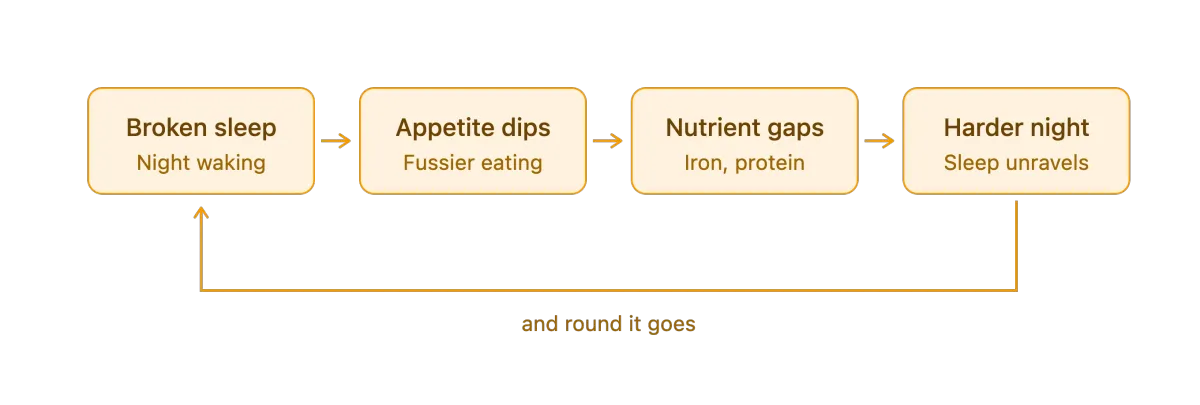
Poor sleep raises hunger hormones and lowers appetite regulation. Tired children reach for quick energy and refuse the foods that would actually help them. Low intake of key nutrients then affects sleep quality that night. Round it goes.
The good news is that a loop runs both ways. Change one point on the circle deliberately and the whole thing starts to turn in your favour.
The 24 Hour Method
Most consultants look at the twelve hours you care about. I look at all twenty four, because that is where the answer usually is.
1. The full picture
A thorough intake covering sleep, feeding, milk intake, meal timing, activity, development and temperament. Not a sleep questionnaire with a nutrition question bolted on the end.
2. Find the actual driver
Night waking is a symptom, not a diagnosis. Sometimes the driver is settling. Sometimes it is an underpowered dinner, an evening milk feed doing too much work, or a nutrient gap. Naming the real driver is most of the job.
3. Adjust both sides together
Meal structure, macronutrient balance, timing of the last substantial food, nutrients that support sleep quality, alongside age appropriate sleep expectations and a routine that fits your child. The two plans are written as one plan.
4. Adjust as your child responds
Two weeks of personalised support while you implement, because real families need to change course, and because a loop takes a little time to turn.
Why I Can Do Both
This is not a sleep consultant who has read about nutrition, or a nutritionist with opinions about bedtime.
I hold clinical training in both. I work with children aged 0 to 7, across sleep and paediatric nutrition, and I have raised four children of my own, so I know what is realistic at 6pm on a Tuesday when everyone is tired.
Almost no one works across both. That is exactly why the connection between them gets missed so often.
I am based in the Sydney Eastern Suburbs and work with families right across Australia by video consultation.
What changes when you look at both
Night waking that settling alone never fixed
Early morning waking driven by hunger rather than habit
Fussy eating that worsens after broken nights
Toddlers who eat well at daycare and refuse dinner at home
Bedtime battles tangled up with the evening meal
Milk feeds that are quietly displacing solids, and sleep
Sleep that improves for a week and then slides back
If you have tried sleep advice alone and it has not held, this is usually why.
FAQs
We only really have a sleep problem, not a feeding one. Is this still for us?
Yes. Many families come to me because of the nights and are surprised that the answer sits in the day. You do not need a feeding concern for this to help. Often the thing keeping a child waking is something in the eating or the timing that no one had connected to sleep yet, and I look at both sides either way, because that is usually where the missing piece is.
What if it is the eating we are worried about, not the sleep?
Same answer from the other direction. Broken sleep makes children hungrier, more irritable and far less willing to try new foods, so feeding rarely improves on its own while the nights are still hard. Working on both together is what makes the progress hold.
What ages do you work with?
Children aged 0 to 7. That runs from newborn feeding and sleep right through to toddler and early childhood fussy eating and bedtime battles. If you are not sure your situation fits, send me a quick message before booking and I will give you a straight answer.
Do we need to live in Sydney to work with you?
No. I am based in the Sydney Eastern Suburbs and work with families right across Australia by video consultation. Everything happens online, so where you live makes no difference to the support you receive.
How quickly will we see a change?
Every child is different, so I am careful not to promise a timeline. What I can tell you is that your consultation includes two weeks of personalised support while you put the plan in place, because a loop takes a little time to turn and real families need to adjust course along the way. Many parents notice things starting to shift inside that window.
What is your sleep approach? I do not want to leave my child to cry.
There is no single rigid method here. The plan is built around age appropriate expectations and a routine that suits your child and your family, not one formula applied to everyone. We talk through what you are comfortable with during the intake, and settling is only one part of a plan that is also addressing the feeding and timing behind the waking.
Does this replace advice from my GP or paediatrician?
No. I work alongside your medical team, not instead of them. If something in your intake points to a medical issue, I will always encourage you to see your GP or paediatrician. My role is the sleep and nutrition picture across the whole day, which is often the piece that has been missing.
Should we start with a consultation or with Growing Foundations?
It depends on where you are. Growing Foundations App is the lower cost way in, with the core of my sleep and nutrition approach in your pocket for one payment and lifetime access, and you can move up to a consultation later if you want a plan built specifically for your child. If you already know you want that tailored support, book the consultation. Either way you are working from the same 24 Hour Method.
Work With The Growing Years
Personalised 1:1 Sleep & Nutrition Consulting
Tailored sleep and nutrition guidance with ongoing check-ins, built around your child and your family's routine.
The Growing Years app
Your sleep and nutrition support, always in your pocket. One payment, lifetime access.
Subscribe to our Mailing List
Weekly sleep and nutrition tips for parents, minus the guilt and the rigid rules. Simple, practical foundations you can actually use, delivered straight to your inbox.
Calmer sleep.
Confident feeding.
Supported families.
© 2026 The Growing Years. All rights reserved.